Family: Beverages
Tea
An infusion of Camellia sinensis leaves; green, black, oolong and white differ by oxidation.
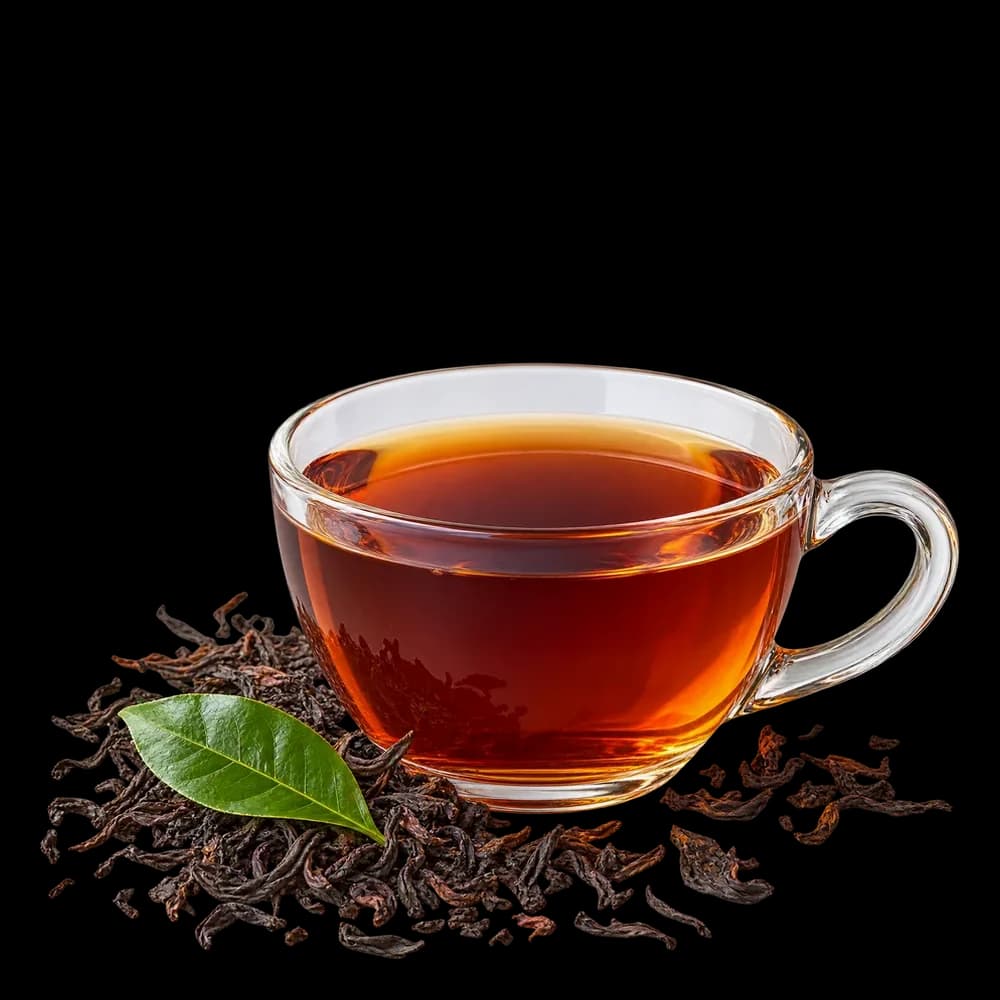
The images are illustrations generated by a neural network, not photographs of the measured sample.
Overview
Tea is an infusion prepared from leaves of Camellia sinensis, producing green, black, oolong, and white types that differ mainly by oxidation. Herbal 'teas' such as chamomile or rooibos come from other plants and have different profiles. A plain cup supplies water, caffeine, and characteristic polyphenols, with essentially no calories unsweetened. Content varies with cultivar, processing, leaf quantity, water temperature, and steeping time. Harvard's Nutrition Source lists tea among beverages compatible with a healthy dietary pattern. Reported values are averages, since brewing choices and additions like milk, sugar, or honey meaningfully alter what ends up in the cup.
Sources and evidence: [1]
Properties
Production method
- How the drink is made
The processing sets the tea type; the degree of oxidation drives the chemical changes
More detail
Fresh Camellia sinensis leaves are processed by different techniques, and it is the processing method that underlies the accepted division into white, green, oolong, black and pu-erh. Differences in the degree and nature of fermentation lead to different chemical changes, and the aroma compounds form during the manufacturing process itself. At the same time the chemical parameters for tea types are still not established, and the effect of processing on the phytochemical profile remains unclear in the literature.
Quality indicators
- How quality is judged
Biochemical composition by standard ISO protocols: extract, theaflavins, polyphenols, ash
What is nearby
Common comparisons
Sources and evidence
Reader reviews
Reviews are published after moderation.
No published reviews yet.